


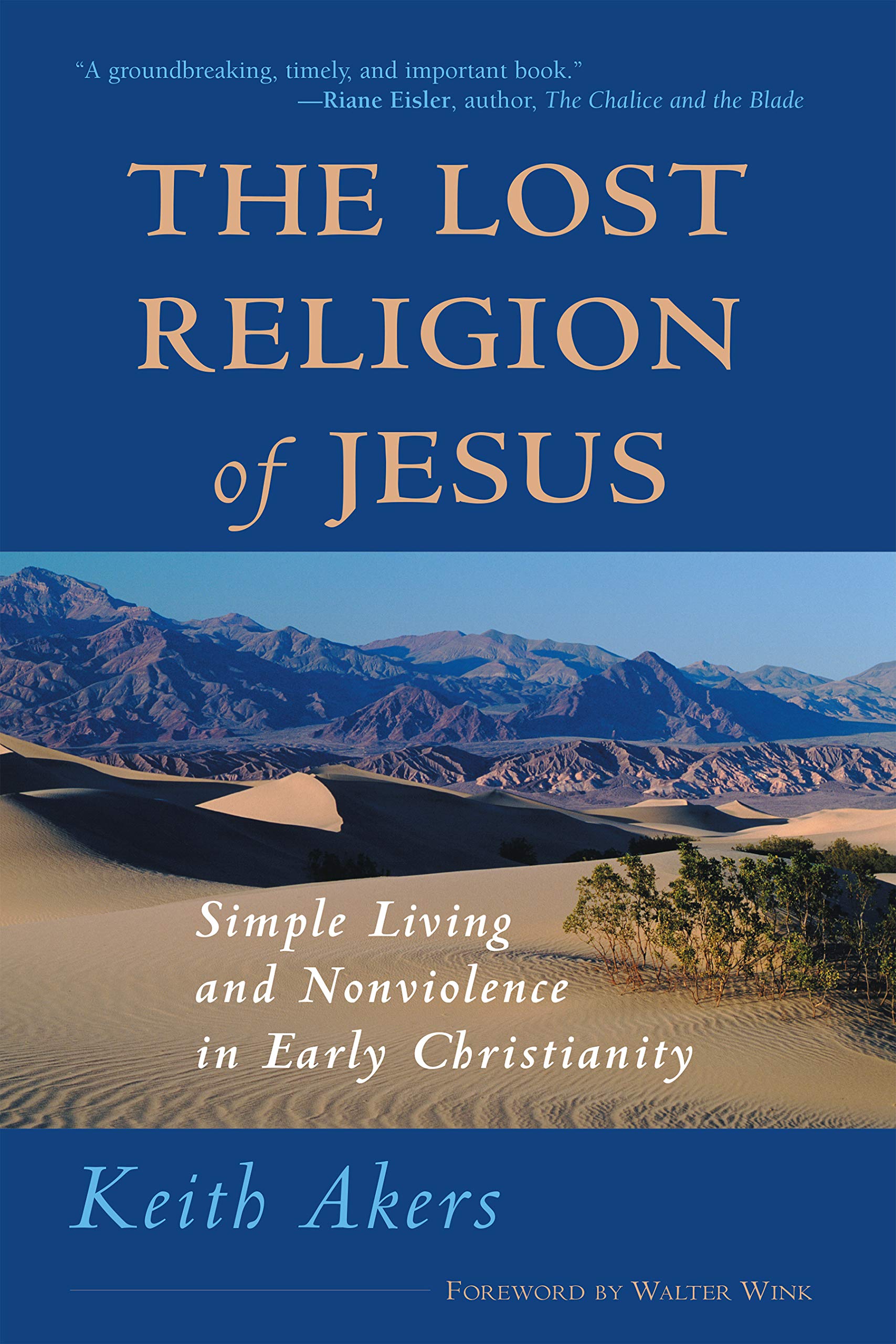
Jesus’ preaching was first and foremost about simple living, pacifism, and vegetarianism; he never intended to create a new religion separate from Judaism. Moreover, Jesus’ radical Jewish ethics, rather than a new theology, distinguished him and his followers from other Jews. It was the earliest followers of Jesus, the Jewish Christians, who understood Jesus better than any of the gentile Christian groups, which are the spiritual ancestors of modern Protestant, Catholic, and Orthodox churches. In this detailed and accessible study, Keith Akers uncovers the history of Jewish Christianity from its origins in the Essenes and John the Baptist, through Jesus, until its disappearance into Islamic mysticism sometime in the seventh or eighth century. Akers argues that only by really understanding this mysterious and much misunderstood strand of early Christianity can we get to the heart of the radical message of Jesus of Nazareth.
Read more
13 reviews for The Lost Religion of Jesus: Simple Living and Nonviolence in Early Christianity
Add a review
Related products


Alternate Religion
$24.00

Alternate Religion
Jesus Was an Airborne Ranger: Find Your Purpose Following the Warrior Christ
$4.99

Alternate Religion
$982.35

$25.00

Alternate Religion
Reading God’s Word 2026: Daily and Sunday Mass Readings Church Year A
$18.00

Alternate Religion
$27.00

Alternate Religion
Ecstasy, Ritual and Alternate Reality: Religion in a Pluralistic World
$24.00
Kriyaban –
This book has completely changed my relationship with Christianity and Christ. Keith does a masterful job of unveiling the true teachings of Yeshua based upon his deep research. If you’re interested in the Essenes, Ebionites, early Christian history, Christian vegetarianism, etc. then this book is for you. I highly recommend this book for Christians looking to deepen their knowledge of authentic Christianity.
mark –
I really like this book. It squares with my own predilections against eating meat and in favor of non-violence. The first part that surveys the diversity and issues surrounding trying to pin down just who and what early Christians were and thought is really informative. Furthermore, it would be unfair to say the author is not schooled in his theological citations and context. However, it is not scholarship, although I think it is adequately scholarly. By that I mean, it is a paean to the Ebionites and vegetarianism. That makes for fascinating, easy reading, and even fun reading, but I don’t know where that leaves you, unless you are preoccupied with those things that pre-occupy the author. You could compare this to someone like Henry Chadwick, for example; a great scholar. This books is far more fun to read. Chadwick looses the reader in detail, minutiae, and almost completely hides a viewpoint. This book is the exact opposite. This is a favorable, kind review, but I can’t give the book more stars.
Amazon Customer –
This was an excellent book. I gave it 4 stars for only one reason…the author kept harping on the vegetarian aspect of Jesus and his followers. What’s wrong with that? The author has already published another book on vegetarianism…he isn’t objective. He used the word “vegetarian” so many times, it was beginning to irritate. If you’re position is strong, there is no need to beat someone over the head with it, and that’s the feeling I had while reading this book.
In his defense, he makes a very compelling argument for Jesus and his followers being vegetarian. You are going to have to decide for yourself whether you take that as “gospel” or not, no pun intended.
Otherwise, the book is wonderful. I am deep into the study of Jesus from a Jewish perspective, and this book illustrated that side very well. For those of you that study Jewish Christianity, it espouses an Ebionite position.
Overall, I highly recommend this book.
Jan. Peregrine –
40-year activist Keith Akers recently appeared in the documentary Christspiracy to answer questions about why Jesus of Nazareth opposed animal sacrifice. I’ve read his 2000 nonfiction book The Lost Religion of Jesus: Simple Living and Nonviolence in Early Christianity, which goes into more detail. He wrote another book fifteen years later called Disciples that sounds like it has more research. This research into Jewish Christianity was sourced from writings from Jewish Christians, church fathers fighting “heresy.” and observant writers like Josephus living at the time. One was opposed to the sect, as was Paul who wrote many of the letters in the New Testament.
Jesus and his disciples, including many of his followers, were Jews and became known as Jewish Christians who believed that Jesus was predicted by Moses to reestablish Jewish Law, not to abolish it. They practiced simple living, nonviolence, and vegetarianism, making Jesus an ethical vegetarian.
Akers explains that there was so much heresy, such as from gnosticism, because Jesus was the first heretic for opposing animal sacrifice at the Jerusalem Temple. He preached mercy, not sacrifice. By doing so he incurred the wrath of the Jewish priests and was crucified by them. Akers points out that the gentiles stripped Jesus of his opposition, saying it was merely about opposing bad moneychangers, and left Jesus as a teacher without a cause with no reason to be murdered.
The first four centuries of the Jesus movement was very divisive and Christianity took over Judaism after several crises happened and the Roman Empire decided to put an end to heresies by claiming Christianity as the official religion.
Jewish Christianity died out not long after because they despised Paul for destroying Jesus’ message and for Paul accepting some of Marcion’s gnostic beliefs. They seem to have sprung up in Islam’s Sufi beliefs, though. Sufi writers have extensively written about Jesus, stories not found in the Christian gospels.
Akers suggests that a great way to practice simple living, even nonviolence, is to become vegetarians. He explains that this will also greatly help our planet’s health and feeding the poor. I agree!
Jesus of Nazareth didn’t intend to create a new religion and he preached that the kingdom of his god is within us. Baptism restores our souls, not the idea that he died for our sins put out by gentiles. I greatly enjoyed this radical book that finally makes sense of Jesus’ ministry and why the New Testament is often confusing.
P. J. Miller –
I love this book! It’s full of so many new insights and makes so much sense to me. The author has definitely done his homework as far as references are concerned. I enjoyed reading the references that were left our of the Christian Bible. I didn’t even know some of these texts existed until I read the book. I consider it a must read for anyone who is ready to update and move out of the programming we received when we arrived on the planet.
S. Hartley –
For those who wish to enlighten themselves about the bible and early Christian who were pacifist vegetarians this is a fascinating book.
Malcolm David –
Read on day of arrival, what initially seemed a mainstream apology soon evolved into an excellent and objective analysis, re the journey from Hebrew roots source… to Pauline Christianity.
My only comments; rather than ‘Jewish Christians’ a better title for this source group (Jews being just one tribe) would be ‘Messianic disciples’ representing all Hebrews as distinct from Sadducees/Pharisees…. as Rabbinic Judaism and Christianity did not exist at that time.
The Clement Recognitions a) Makes clear that Paul incited the riots and actually caused the death of James. b) and states that ‘Satan would send his apostates to deceive mankind’ (Homily XI:35) sounds like Paul to me, plus c) Peter recognised a false gospel has to be preached first.
The overall sentiments re vegetarianism and animals rightly reflect a true Jesus who would not eat dead flesh, but did not explain animal sacrifice was really introduced by Moses because it was one step better than child sacrifice (Moloch) still practised today with abortion. World can only heal when both this and animal abuse is stopped. Nevertheless a highly recommended insight with very clear summaries
Richard Jones –
This book shows a more than acceptable level of scholarship from an author outside the field and is a well written easy read. The essential premise is logically, progressively and compellingly advanced if perhaps coming across as something of an oversimplification: I was left with a sense that while wanting to accept the arguments of the book, a comfortable secure western twenty first century perspective might be imposing a lens on actual causes and motivations back in the first.
In drawing attention to a wrong turn taken by the evolving Christian religion away from the actual teachings and nature of Jesus, the author does come across as having his own agenda to push – the avocation of a vegetarian lifestyle. I had a sense of the book being used to justify and advance this from a historical religious perspective, not too surprisingly perhaps given the authors position as displayed by his other work. This feeling appeared to be born out by the authors closing words. I support and endorse his sentiments, but can’t help feeling that a little optimistic wishful thinking might have hung over the analysis.
With the rise of right wing religious conservatism and the larger picture of global problems such as climate change, the widening gap between rich and poor etc. I recommend this book for providing easy access to valid alternate perspectives in the secular/religious debate and for raising the suggestion of a historical justification for other paths and personal choices.
Joseph A. Schrock –
In his book “The Lost Religion of Jesus”, Keith Akers renders a good service to thinkers and spiritual seekers who wish to know what early Christianity was like, as well as what Jesus’ early followers REALLY believed about him and his teachings. Although I was less than fully persuaded by Akers’ arguments that Jesus was a vegetarian, I can certainly not begin to argue with his claims that Jesus was a committed pacifist, that he unquestionably taught his followers nonviolence, peace, love for others, and simple, humble living.
The Ebionites (a branch of Jewish Christians) might well have been the most faithful devotees of the true teachings of Jesus of Nazareth of any branch of Christianity. Certainly, Akers subscribes to this viewpoint, and he marshals very considerable evidence in favor of that outlook.
It is clear to any intelligent, rational, and objective thinker that Jesus and his early disciples subscribed to a spiritual worldview that is so far afield of Orthodox Christianity that if Jesus were to appear now in this world, “Christianity”, as it is widely practiced, would be an entirely foreign religion to him. He could not recognize it as stemming from his life and teachings.
I recommend Keith Akers rather insightful, scholarly, and rational analysis of early Christianity, and especially the Jewish Christians who deviated far less from Jesus’ teachings as found in the synoptic Gospels than any other branch of Christianity. His book is worth reading.
Oleg –
The Lost Religion of Jesus was one of the most thought provoking books on historical Jesus I have read. It somehow shifted the paradigm of my understanding of many aspects of Early Christianity.
First, I came to know that the history of Christianity cannot be stripped down from now to the past, but rather one has to learn about the schisms in the early church and the reasons behind them. Here, I was amazed to learn about the dispute between Paul vs James/Peter over vegetarianism.
Second, I fully realized how much the historical events rather than the teaching itself influenced the type of Christianity that survived. The spread of Gentile Christianity can be associated with the destruction of Jerusalem and Bar Kokhba revolt that negatively affected Jewish Christianity.
Finally, I got a great deal of information about the Ebionites as the “true” followers of Jesus. Reading the Gospels, I always felt that they consist of three parts: 1.) the message of Jesus; 2). the message of Paul; 3). theological interpolations. Basically, the first part is what always interested me. It is about simple life, non-violence and vegetarianism and It is in line with many other spiritual traditions. The Paul’s additions as well as those of church fathers’ ones only distorted the message completely. Thus, Akers helped me to learn about real historical practitioners of the Religion of Jesus.
Responding to the other reviewers’ criticism about too much vegetarianism in the book, I can only say that this was an essential part of the Jesus’ message. This is the most important issue to understand about the dispute between James/Peter, who saw vegetarianism as essential and Paul, who in the very same manner thought that this is something not to care about.
To sum up, this is a great book and a must read for every open-minded being who seeks an understanding of a true message of Jesus.
Mahatma Gandhi –
Buy this to know what original Christianity was all about. Modern day Christianity is only for having more followers. Also doesn’t support vegetarian food 🥝 🥑 diet.
Valerie Dixon –
Very informative
Tom Stuart –
I was a bit stuck with rating it because it was an important book to me. However, I find Akers writing style too polemical. What I valued was the alternate perspectives, and information that is new to me. I’m recognising that the “received tradition” of the Jesus story has been pared down to a Greek/Western perspective. Amazingly there is still yet so much more to be realised about the Jesus event when listening to all the responses and not just the so called “authorised” version.