
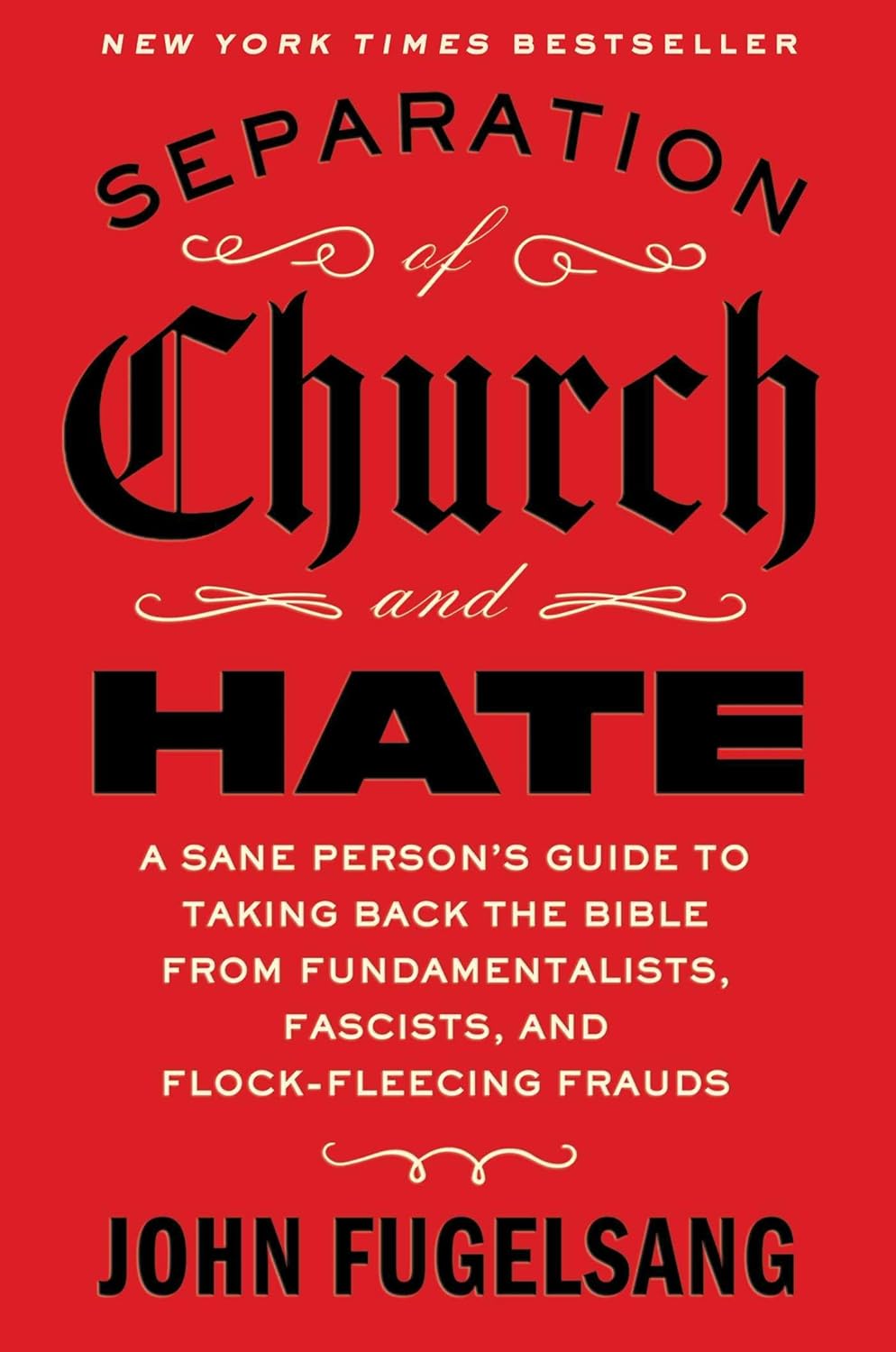
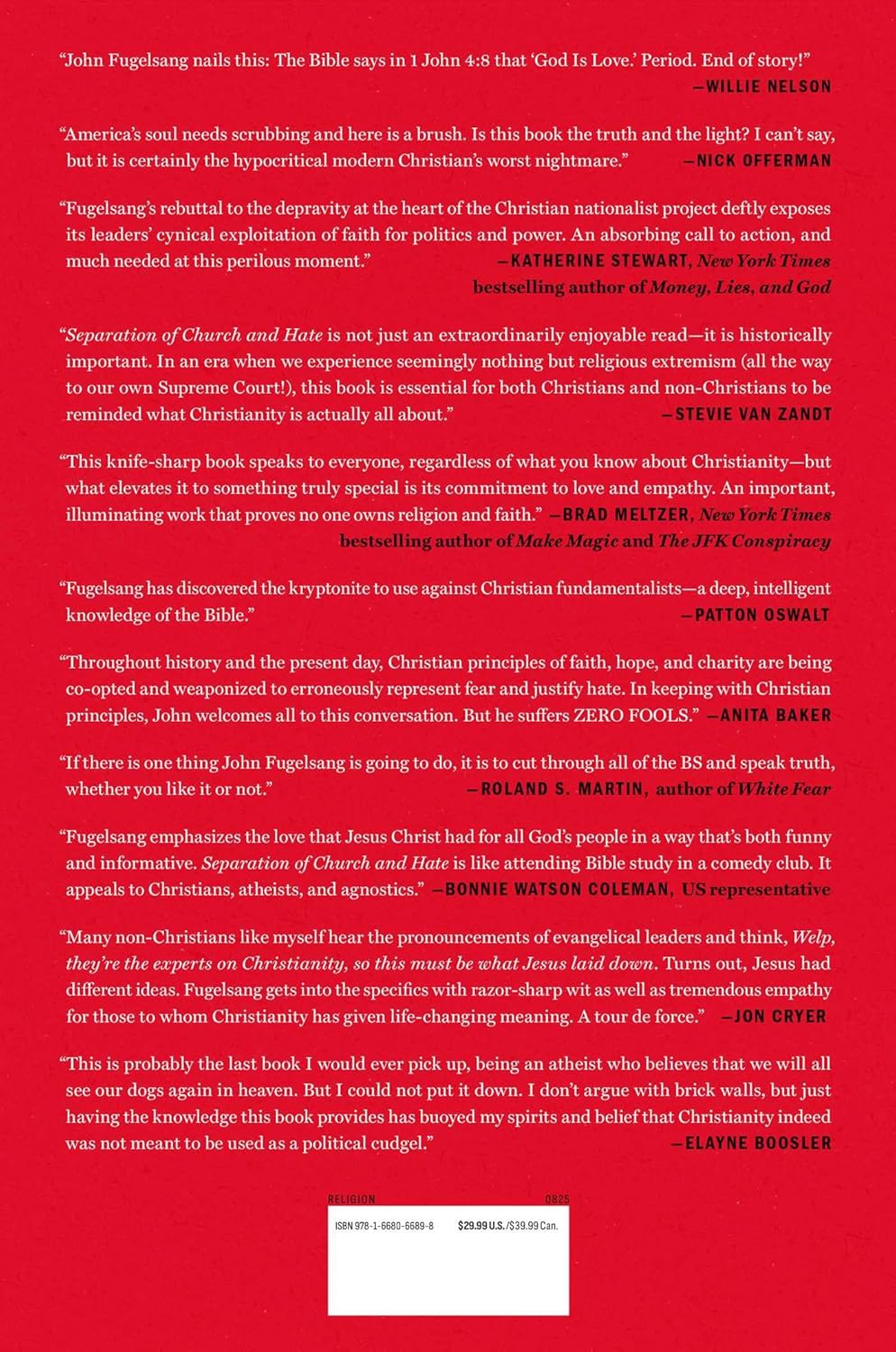

For more than two centuries, the United States Constitution has given us the right to a society where church and state exist independently. But Christianity has been hijacked by far-right groups and politicians who seek to impose their narrow views on government, often to justify oppressive and unequal policies. The extremists who weaponize the Bible for earthly power aren’t actually on the side of Jesus—and historically they never have been. How do we fight back against those acting—literally—in bad faith?
Comedian and broadcaster John Fugelsang finally offers the answers. In this informative, perspective-shifting book, Fugelsang takes readers through common fundamentalist arguments on abortion, immigration, LGBTQ rights, and more—exposing their hypocrisy and inaccuracy through scripture, common sense, and deeply inappropriate humor. It offers practical tips on how to debate your loved one, coworker, or neighbor on the issues that divide us using that Bible they claim to follow.
But Fugelsang’s message is about more than just taking down hypocrites. It’s about fighting for the love, mercy, and service that are supposed to make up the heart of Christianity. Told with Fugelsang’s trademark blend of radical honesty, comedy, and deep political and religious knowledge, Separation of Church and Hate is the book every American needs today. It’s a rallying cry for compassion and clarity for anyone of any faith who’s sick of religion being used as a cloaking device for hate.
Read more
13 reviews for Separation of Church and Hate: A Sane Person’s Guide to Taking Back the Bible from Fundamentalists, Fascists, and Flock-Fleecing Frauds
Add a review
Related products


Religion

Religion

Religion

Religion

Ms. P. A. Walton –
A step back to look at the bigger picture of some of the interpretations of Scripture you may never have questioned. While I may not quite agree with everything in the book it was refreshing to be challenged. I was pleasantly surprised as I now understand why I feel a compassion for those who don’t fit societies mould and am reminded that this is what Jesus’ taught. The book is a great source of sitting and reviewing your own opinions. It is a reminder that Jesus often had to question the religious who had a tendency to miss the heart, soul and spirit of his teachings. I am not alone in needing this! It is a good book for Christians and ex -Christians who have walked away from a religion that has lost its way in todays world.
linda –
Absolut the best read in a long time. An eye opener
bryne blonski –
A must read !!!!!!!
Dee –
Brilliant book! I have bookmarked nearly every page because of the insights it provides. Fugelsang uses a balance of appropriate humour combined with incredible knowledge, challenging the hate and harm of those weaponising scripture to support their supremacist ideology.
The book is not for those too lazy to show compassion for our global community (and how we are all connected), but helps those who want to challenge the harmful discourse of those who’d rather spread hate, than the actual teachings of Jesus.
MamasGottaRead –
If you’re feeling overwhelmed by the divisive atmosphere in our nation, tired of the endless stream of confusing rhetoric, or even if you’re convinced that the current events in the United States are straight out of the bible, then you MUST READ THIS BOOK NOW! Everyone across the political spectrum – from both sides of the aisle – would benefit from this book.
John Fugelsang has crafted an in-depth – albeit sometimes slightly irreverent – exploration of the true motives behind the actions of today’s administration. Are these actions aligned with true Christian principles? You’ll have to dive in to this book to fully understand. It’s penned by a comedian whose unique perspective comes from being the son of a former Catholic nun and a Franciscan brother, so you’ll certainly gain a whole new perspective by reading it!
I WHOLEHEARTEDLY RECOMMEND this book to both believers and non-believers alike! It’s a fantastic resource to help you navigate the tumultuous times we’re facing.
Mike Dillemuth –
An enlightening book for readers who have read the bible and those who have not. The author makes his observations with extreme clarity. In addition, his sarcastic and humorous writing style makes this book very entertaining.
It highlights biblical concepts that are often misinterpreted. The author does this by citing specific bible passages that run counter to themes endorsed by some conservative Christian leaders. For the most part, his analysis is right on target. I only found one cited passage that was out of context.
Some people cite bible passages that quote Paul. The author notes, however, that Paul was not a disciple. When seeking insight from the bible, one should follow the teaching of Jesus, not Paul. This bit of contextual clarity is an effective tool at getting the reader to reexamine what they think about Christianity.
The author also makes modern day comparisons to show inconstancies between what is said by religious leaders and what is stated in the bible. He notes how some people will use a passage from Paul to validate certain behavior. As Paul was not Jesus, quoting him is like quoting a review of the movie “The Godfather” and claiming the review was part of the actual movie script itself.
Overall, the author is very good about putting scripture into context. One example is the story of the two sisters from Ezekial 23 which is full of idolatry and prostitution. Despite its pornographic content, the author correctly notes that it is not a lurid tale of two women but rather an allegory representing the kingdoms of Israel and Judah.
Bottom Line. This book is both informative and entertaining. Regardless of the one’s belief or non-belief in religion, this book will definitely get the reader to think about the true meaning of Christianity.
MAW –
Good, easy read. Probably could have been a lot shorter, but for someone who has never studied the Bible, it was worth the read.
Royce Green –
Over the past few years I’ve spent a great deal of time studying and writing about Christian nationalism, and I opened this book feeling both informed and exhausted. I wasn’t looking for another dense analysis; I was longing for emotional relief and practical guidance — something that could help me move from understanding the problem to living a more Christ‑shaped response. To my surprise, John Fugelsang delivered exactly that.
I’ll be honest: the irreverence sprinkled throughout the book made me pause at times. But what ultimately grounded me wasn’t his comedic background — I already knew that — it was the surprising depth of his theological and biblical insight, especially his grasp of Jesus’ teachings. That depth kept the humor from feeling flippant. Instead, it became a disarming way of approaching a deeply serious subject. His wit never trivializes the issues; it keeps the reader engaged long enough to absorb the truth, and the substance beneath it all is what truly impressed me.
Fugelsang reframes Jesus, Paul, and scripture in ways that clear away the distortions Christian nationalism depends on. He brings these figures back into their historical and moral context with clarity and honesty, helping the reader see the heart of their teachings without the layers of cultural baggage that often obscure them. That alone felt like a breath of fresh air.
But the real strength of this book lies in how he tackles the social issues Christian nationalism distorts — immigration, racial justice, LGBTQ+ dignity, poverty, guns, reproductive justice, and more. These are heavy topics, yet he presents them with such clarity, compassion, and grounded humor that I never felt overwhelmed. Instead, I felt drawn deeper into the heart of Jesus’ command to love our neighbors as ourselves. That simple, profound ethic becomes the thread that ties every chapter together.
As someone who cares about history, I was moved by the way he highlights the people — some familiar, some new to me — who resisted the church’s complicity in oppression across generations. Their stories reminded me that faithful resistance has always existed. That gave me hope, not the naïve kind, but the grounded hope that comes from remembering we walk a path others have walked before us.
The final chapter is where everything comes together. Fugelsang draws a needed distinction between “Christians” as a cultural identity and Christ‑followers as a lived ethic. He names the temptations of power, coercion, and control — the same temptations Jesus rejected — and contrasts them with the way of love, humility, and neighbor‑embrace. As someone committed to spiritual formation and Christlikeness, I found this both convicting and deeply encouraging.
This book helped me see more clearly the spiritual roots of Christian nationalism: the fear that, if power ever shifts, they will finally face the very wounds they once inflicted. That fear fuels domination and supremacy. But the gospel calls us to something entirely different — to lay down our lives for others, even those who oppose us, and to trust that love, not fear, is the way of Christ.
If you care about religious liberty, social justice, or the integrity of the gospel…
If you’re tired of watching the church chase power instead of love…
If you want a book that tackles a heavy subject with honesty, humor, and theological depth…
If you long to align your life with the teachings of Jesus in a way that transforms both your heart and the world around you…
I highly recommend this book.
It rekindled my hope, clarified my calling, and reminded me that the journey toward Christlikeness — spiritually, civically, and communally — is both possible and necessary. And somehow, Fugelsang made the journey engaging, accessible, and even enjoyable along the way.
Laura –
Love God and love you neighbor. So simple, if only everyone agreed.
I loved the perspective on Paul the apostle, that makes a lot of sense to me. I also liked the background into some of the stories from the Bible. Let’s call them a closer look. Oh and the relationship between David and Jonathan, I have always thought that was the case too. Well done.
Andrew Lee –
I bought this as a gift for my Mother and she absolutely loved it!
Vince –
Just the book that I needed! Being a practicing Catholic who loves his faith, but also struggles with the challenge of living that faith, I found Fugelsang’s upbringing and perspectives to be quite relatable, credible, and basically perfect for addressing so much of the Christian nationalist hypocrisy that has hijacked this nation. “Separation of C and H” presents cogent arguments that point out this hypocrisy in a digestible format, with humor and sincerity as a chaser. I can clearly sense Fugelsang’s concern, and I admire and appreciate his confidence in what he is presenting to the reader – the facts he gathers from sources and historical/biblical references are powerful. I have already used some of Fugelsang’s Beatitude references to quash a family member’s assertions that Pope Leo is “bad”. This book is truly an informative AND entertaining read. I can humbly state that as a result of reading this book, I feel closer to my faith and my desire to be the best Christian/Catholic and more importantly, person, that I always strive to be.
Loraine E Chapin –
This is a FANTASTIC book. It has helped me tremendously understand how christianity and indeed other main stream religions have been co-opted by “fake” Christians. I feel ore confident when engaging with these fake Christions. I simply say first, “wow, you’re very passionate about this (and the “this” could be guns, abortion, imprisoning those who are not citizens yet, etc..” I then follow it with, “please tell me where in the Bible Jesus says or advocates this?” They can’t. Why, Jesus NEVER said any of the horrible things promulgated by these “christian nationalists, aka fake christians.” It is meant for EVERYONE. Christians, Muslims, Jews, Agnostics, Athiests, truly everyone. And, it is not only insightful, it is funny. Thank you John Fuglesang. You are doing your dad (a former brother) and your mom (a former sister) proud.
T.A. Fisher –
An excellent exploration of how the Bible and Christianity are often misused and misunderstood in US society. A good resource for those engaging with Christian nationalists and/or fundamentalists or tempted to do so. I also appreciated the humorous and engaging tone.
Part of me wanted to immediately go out and get a few different versions of the Bible to do my own in-depth study. But then I remembered how we are talking about translated interpretations of translations that were also interpreted, as that cannot be helped in the world of translation. And that this has happened many times over from works originally told rather than written and read. Which made me wonder what would be the point. But I’m glad Fugelsang put in the work.